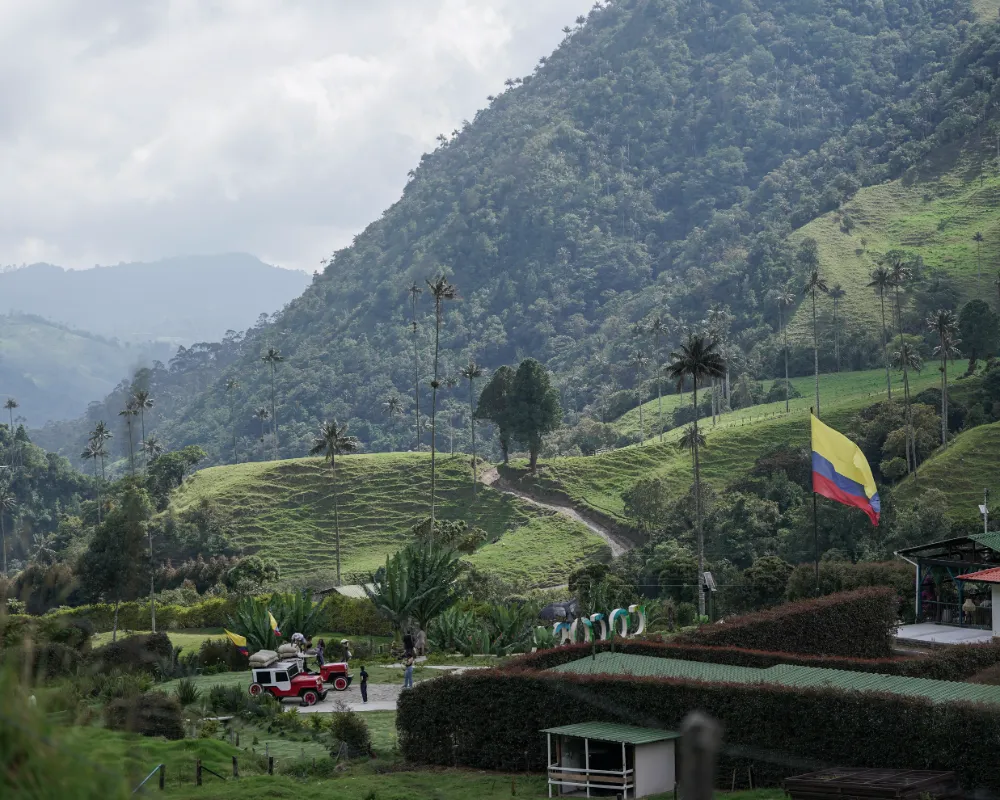
What is kept alive here outside a display case: the architecture of the colonisation, the trades still at work, the Yipao, the trova and the festivals that take over a whole town.
Culture in Quindío is not visited in a room full of display cases: you run into it in the street. It is in the bahareque houses, in the hands weaving vine, in a jeep loaded past the point of reason, and in the week a whole town stops working in order to celebrate. This guide explains what you are looking at when you see it, which is the difference between a nice photograph and a visit you actually understood.
The architecture tells the story of the colonisation
The historic centres of Salento and Filandia are not stage sets: they are how this area was built little more than a century ago, when families from Antioquia settled these mountains. The material is bahareque — a frame of guadua bamboo and timber packed with earth — and the character is in the balconies, the doors and the colours, chosen house by house. That way of building and living is part of what UNESCO recognised when it listed the Coffee Cultural Landscape as World Heritage.
Trades that are still at work
- Basketry. In Filandia the vine is still woven by hand, with techniques passed down within families. The full story is in Del Bejuco al Canasto.
- The muleteers. Before the roads, everything came in and out on muleback. In Quimbaya, Parque Los Arrieros puts that trade on stage.
- Coffee. Also a trade, not just a product: who picks it, how it is processed and who decides the roast. We go into it in the guide on Quindío coffee.
The Yipao and the trova
Two expressions you will meet at any celebration, and which resemble nothing else:
The Yipao
Willys jeeps arrived after the war and became the working tool of the coffee countryside. The Yipao is the parade in which they are loaded to absurdity: coffee, plantain, furniture, even a family's entire house — the coroteo — finishing with the jeep up on two wheels. It is technical pride and comedy at the same time.
The trova
Duels of improvised sung verse, with guitar, in which two troveros answer each other with wit until one runs out of road. You do not need to catch every local reference to enjoy it; the crowd reacts, and that already tells you who is winning.
Festivals take over the whole town
If your trip lands on a festival, change the plan: the streets fill, accommodation prices move and the town's whole agenda turns around the event. These are the ones we have covered:
- Fiestas del Quindío, the department-wide celebration.
- Fiestas del Café, in Calarcá.
- Fiestas de la Libertad, in Circasia.
The final programme is always confirmed by its organiser and can change up to the last minute, so check close to the date. In Events and Fairs we keep publishing what we cover.
Museums and collections
For the display-case side of things, two references: the Museo del Oro Quimbaya, in Armenia, holding the goldwork of the society that lived in this region before the colonisation; and the Jardín Botánico del Quindío, in Calarcá, where the territory is read botanically. Confirm opening times and visiting conditions with each of them before you go.
How to look without intruding
- Ask before photographing someone at work. They almost always say yes, and the conversation that opens up is worth more than the picture.
- Buy directly from the maker where you can, and do not haggle over the craft: there are days of work behind a basket.
- Remember that many houses in the historic centres are homes, not attractions. The pretty courtyard you can see from the street is somebody's living room.
- At festivals, follow the town's rhythm: the street belongs to everyone, but the celebration is theirs.